
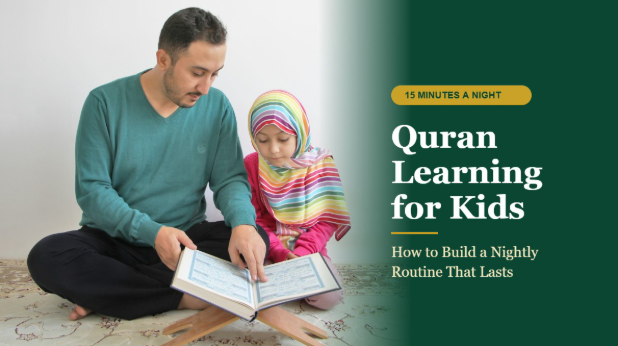
Most parents do not struggle with wanting their children to learn the Quran. They struggle with when. School runs late, homework piles up, and by the time everyone has eaten, the day is gone. Weekend classes help, but a child who only opens the mushaf once a week forgets almost as fast as they learn.
The good news is that kids don’t need long Quran sessions. It needs a short, fixed time that happens every day. For most families, the easiest slot is the one that already exists: bedtime.
This guide shows you how to build a 15-minute nightly Quran routine at home, what to teach first, and how to keep it going when motivation dips.
Why Bedtime Works So Well for Children
Bedtime is the one part of the day that rarely changes. Children already expect a sequence: wash, change, brush teeth, lie down. Adding Quran to that sequence means it builds on an existing habit, rather than fighting for a new slot.
It also follows the Sunnah. The Prophet ﷺ had a set of surahs and duas that he recited every night before sleeping. When children learn their Quran at the same time, they are not only memorising. They are learning how a Muslim ends the day.
There is a practical reason too. A tired child cannot manage an hour of lessons, but ten or fifteen calm minutes is just right. Short sessions finish before attention runs out, so the child goes to sleep remembering the Quran as something pleasant.
The 15 Minute Nightly Routine
Keep the routine the same every night. Children feel safe with structure, and repetition is what makes memorisation stick.
- Minutes 1 to 3: settle down. Lights low, phones away, and sit together on the bed or prayer mat. Begin with Bismillah.
- Minutes 3 to 8: revise. Recite together everything the child already knows. Revision always comes before anything new.
- Minutes 8 to 12: learn something new. One verse, or for younger children, one short phrase. Say it, let them repeat it three times, then join it to what they learnt yesterday.
- Minutes 12 to 15: meaning and dua. Share one sentence about what tonight’s verse means, then end with the dua before sleeping.
That is all. Fifteen minutes a night adds up to more than ninety hours of Quran learning in a year, which is far more than most weekend classes give.
What to Teach First
Start with what is short, rhythmic and used every day. A sensible order for most children is:
- Surah Al-Fatihah, because they need it in every prayer.
- The three Quls: Al-Ikhlas, Al-Falaq and An-Nas. The Prophet ﷺ recited these every night before sleeping, blew into his hands and wiped them over his body (Sahih al-Bukhari 5017). Children love doing this with you.
- Ayatul Kursi, once the short surahs are solid. Whoever recites it when going to bed has a guardian from Allah through the night (Sahih al-Bukhari 2311).
- The rest of Juz Amma, working from the shortest surahs upwards.
If your child has not yet learnt to read Arabic letters, pair the routine with Noorani Qaida practice during the day. The bedtime routine can then focus on listening and repeating.
Moving On to Surah Mulk
Once your child is comfortable with the short surahs, Surah Al-Mulk is a natural next goal. It is only 30 verses long, and the Prophet ﷺ did not sleep until he had recited it (Jami at-Tirmidhi 2892). He also said that this surah of thirty verses interceded for a man until he was forgiven (Jami at-Tirmidhi 2891).
The easiest way is one verse a night. Thirty nights, thirty verses. Keep a printed copy by the bed so your child sees the same page every night. A free Surah Mulk PDF with Urdu and English translation works well, because you can read the meaning of each verse together before you memorise it.
Let your child tick off each verse on a small chart. Watching the ticks grow is a strong motivator, especially for children between six and ten.
Make the Meaning Come Alive
Children remember what they understand. Before you memorise a verse, spend one minute on what it means, in words a child would use.
- When you reach the verse about birds held in the sky by none but the Most Merciful (67:19), go to the window the next morning and watch the birds together.
- When you read about water sinking into the earth (67:30), ask your child where water would come from if every tap ran dry.
- For Surah Al-Ikhlas, ask them to think of anything in the world that has no beginning. Nothing does, except Allah.
These small conversations turn memorisation into something personal. They also build the habit of reflecting on the Quran, which matters as much as reciting it.
Keeping Children Motivated
Every parent hits a week where the routine slips. A few things help:
- Praise effort, not speed. A child who revised well deserves more praise than one who rushed through a new verse.
- Let them teach you. Children love being the teacher. Ask them to correct your recitation now and then.
- Celebrate milestones. Finishing a surah is a big moment. A phone call to a grandparent to recite it, or leading the family in a short recitation, means more to a child than a toy.
- Do not punish missed nights. If a night is missed, simply carry on the next night. Guilt kills routines faster than anything else.
- Be the example. Children copy what they see. If they see you reading the Quran, they will want to do the same.
When to Bring in a Teacher
A nightly routine at home is powerful, but parents are not always sure about pronunciation. Small mistakes in tajweed are easy to fix early and hard to fix once they become habits.
A short weekly session with a qualified teacher fits well alongside the routine. The teacher corrects pronunciation and introduces new rules. You keep the daily revision going at home. Together, the two make steady progress far more likely than either one alone.
Frequently Asked Questions
What age should Quran learning for kids start?
Many children begin listening and repeating short surahs from around age four. Reading with the Arabic letters usually starts between five and seven, once the child can sit for a short lesson.
How long should a child’s Quran session be?
For children under ten, 10 to 15 minutes a day works better than one long weekly session. Daily repetition is what makes memorisation last.
What if my child forgets what they learnt?
Spend more of each session on revision and less on new verses. Forgetting usually means new material is coming in faster than old material is being revised.
Final Thoughts
Quran learning for kids does not have to be a battle. Choose one calm moment each day, keep it short, and keep it the same. Start with the short surahs, add Ayatul Kursi, then work towards Surah Mulk one verse at a time. Within a year, your child can carry a good portion of the Quran in their heart, and the habit you built together at bedtime can stay with them for life.