
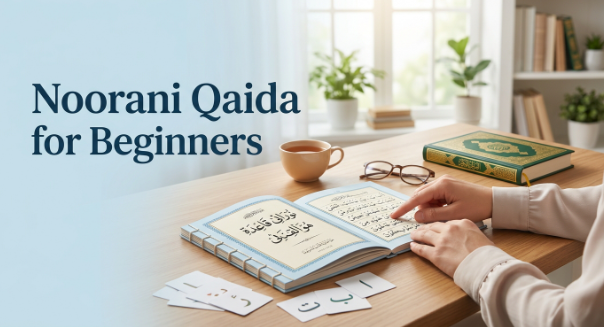
The process of learning to read the Holy Quran is beautiful, but new learners usually need a simple and well-organised starting point, which the Noorani Qaida for beginners offers by teaching students the Arabic letters, how to pronounce them, the vowel marks, and the fundamental rules required for accurate Quranic reading.
Noorani Qaida is helpful for anyone, whether they are a child beginning their lessons in the Quran or an adult who is going back to studying the Quran after a long time, as it can help build their confidence before they proceed to full Quran recitation.
What Is Noorani Qaida?
Noorani Qaida is a guide for beginners which is used for teaching the basic principles of reading Arabic and the Holy Quran; rather than at once requiring the learner to read full Quranic verses, it slowly presents the sounds, letters, combinations, and pronunciation patterns necessary for reciting the Quran.
A typical Noorani Qaida covers:
- Arabic letters and their correct sounds
- Joining Arabic letters
- Harakat and vowel sounds
- Tanween
- Sukoon
- Shaddah
- Madd
- Basic pronunciation rules
- Introduction to essential Tajweed concepts
The step-by-step method means that the Noorani Qaida designed for beginners is especially useful for people who have little or no prior experience of Arabic.
What is the importance of Noorani Qaida for beginners?
It can be difficult to start with the Quran unless you are already familiar with the sounds of the Arabic letters. The Noorani Qaida helps learners acquire these fundamental skills first.
A major advantage is that it helps with pronunciation. Since Arabic includes sounds which may not be present in the learner’s native language, it is not sufficient for learners merely to recognise a letter; they have to know how each letter should be pronounced and also how the sound changes when it is combined with different vowel marks or combinations.
Having a solid foundation can make it easier to carry on with later Quranic reading and will help learners get more used to Tajweed.
How Noorani Qaida Builds Quran Reading Skills
To learn how to read the Quran is a step-by-step affair, and the Noorani Qaida divides that process into manageable stages.
A person who is just starting can begin by identifying the individual Arabic letters. When they are used to these letters, the learner then moves on to joining the letters and reading simple combinations. In later lessons, the different vowel sounds and pronunciation patterns are introduced.
Through regular practice, learners slowly progress from being able to identify individual sounds to reading words and finally to reading Quranic verses.
One of the reasons why the Noorani Qaida for beginners is so widely used in the teaching of the Quran is its structured progression.
Who can learn Noorani Qaida?
The Noorani Qaida is not something that is only suitable for young children; it can be of benefit to almost anyone who wishes to improve their basic skills in reading the Quran.
Children:
Children may use the Noorani Qaida as their first step in learning to read the Quran, and short, step-by-step lessons can make the process easier and less overwhelming.
Adults:
Adults who have never learned to read Arabic or who wish to correct their old pronunciation habits can also begin with the fundamentals.
New Quran Learners:
People who are starting their journey into learning the Quran can use Noorani Qaida to get used to reading Arabic before moving on to longer passages from the Quran.
Learners Improving Their Recitation:
A person who is already able to read the Quran might go back to the Qaida lessons in order to revise their pronunciation and improve their basic skills.
What is the relationship between Noorani Qaida and Tajweed?
Tajweed consists of the rules and principles that should be applied when reciting the Quran correctly. Although the Noorani Qaida is not a full replacement for studying Tajweed, it does introduce learners to a number of pronunciation topics which enable them to move on to more advanced recitation.
For instance, learners get used to Harakat, Sukoon, Shaddah, Madd, and the other ways of reading. Once these basic elements have been learned, formal Tajweed lessons can then be more easily understood.
The aim goes beyond reading quickly; it is to achieve correct pronunciation and then to steadily enhance the quality of the Quranic recitation.
How long does it take to learn Noorani Qaida?
The time needed to complete the Noorani Qaida is not fixed, progress varying according to the learner’s age, previous experience, how often the lessons are taken, and the amount of regular practice.
A child who practices regularly can make different progress to an adult who studies only a few times a week.
Instead of merely aiming to complete the book quickly, beginning learners should pay attention to understanding each lesson and fixing their pronunciation before proceeding.
It is better to be consistent than to be fast.
How to Learn Noorani Qaida Effectively?
You can make your learning more effective by following a few simple habits:
- It is important to practice regularly, since even a few minutes of practice each day are more beneficial than studying once a week.
- Attention should be paid to the way each Arabic letter is pronounced.
- Reading aloud is necessary since silent reading does not give adequate practice for the development of recitation skills.
- Go over difficult lessons. Don’t skip a lesson simply because you haven’t mastered it.
- It is best to study with a qualified teacher, since a teacher is able to detect pronunciation errors that might be hard for you to spot yourself.
- Go over the lessons that were covered before. Frequently revising them will help to avoid forgetting the earlier concepts.
Is it possible to learn Noorani Qaida online?
Certainly. Nowadays, people are able to read the Noorani Qaida online and can use various digital resources to practice from home. For families which need flexible schedules or who live in areas where it is not easy to find local Quran teachers, online Quran learning is especially convenient.
A PDF of the Noorani Qaida also makes it convenient to carry out the practice since the lessons can be accessed from a computer, a tablet, or a mobile device. Yet digital resources function most effectively when they are combined with appropriate instruction and consistent pronunciation practice.
Noorani Qaida for Kids: Making Quran Learning Easier:
The way children first encounter the study of the Quran can have an effect on their feelings about Islamic education, so the lessons must be clear, encouraging and suitable for their age.
Parents should establish a regular learning routine instead of urging their children to finish the lessons quickly. By having short practice sessions, giving positive encouragement, and carrying out regular revision, children can develop their confidence.
A well-qualified teacher is also in a position to give individual corrections and help the child with troublesome pronunciation points.
Common Mistakes Beginners Should Avoid:
New learners often concentrate too much on filling pages and not enough on proper pronunciation. Among the common errors are:
- Moving to Quran reading before mastering basic letters
- Ignoring difficult Arabic sounds
- Reading too quickly
- Skipping revision
- Practicing incorrect pronunciation repeatedly
- Assuming that recognizing an Arabic letter means knowing how to pronounce it correctly
If you take the time to establish the basics, you can avoid having these problems later on.
Why a Strong Foundation Matters?
Learning to read the Quran is not a race; the reason for starting with Noorani Qaida is so as to acquire the skills necessary for accurate and confident recitation.
Only when learners have come to understand the Arabic letters, how they are pronounced, the vowel marks, and the basic rules for reading can they build a firm basis for moving on to Quran recitation and Tajweed.
That is why the Noorani Qaida, suitable for beginners, can be an important first step for both children and adults who wish to learn the Quran correctly.
Start Your Quran Learning Journey with Confidence:
All those who learn the Quran have to start somewhere, and for a great many beginners that first move consists of learning the Arabic alphabet and getting a clear understanding of how its sounds function.
By being patient, practising regularly and receiving guidance from a qualified teacher, learners will be able to progress gradually from reading basic Arabic to reciting the Quran with confidence. The Noorani Qaida offers a structured starting point which makes it easier to follow this journey.
What’s most important is to start, remain consistent, and gradually improve one lesson at a time.